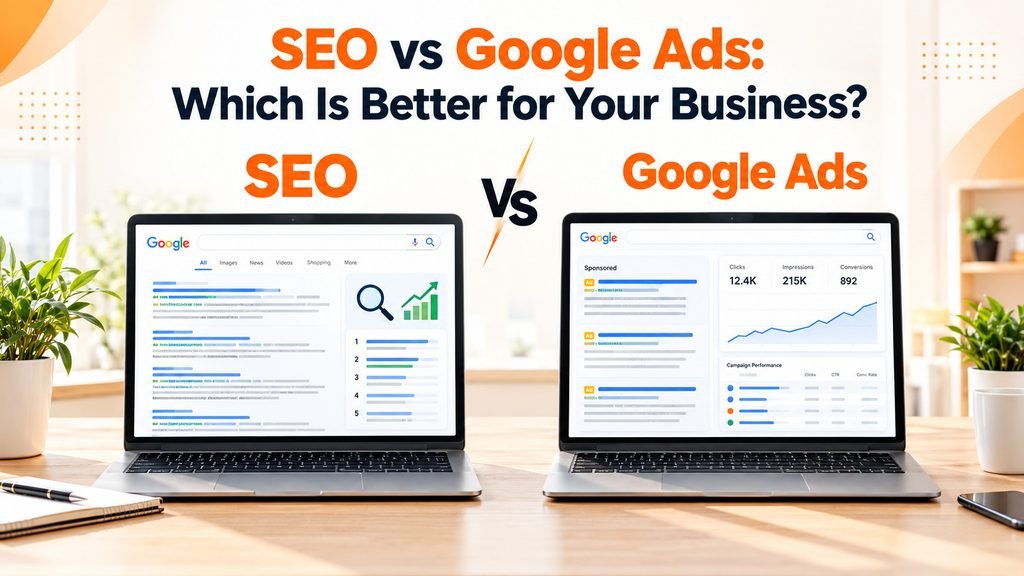
If you want more customers from Google, you have two main routes: earn a place in the organic results through search engine optimisation (SEO), or pay for a place at the top with Google Ads. Business owners ask us about SEO vs Google Ads almost every week, and the honest answer is that neither is always better. The right choice depends on your budget, how quickly you need leads, how long your customers take to decide, and how competitive your market is.
SEO builds lasting organic visibility at a lower long-run cost, but it usually takes months to show results. Google Ads buys immediate, controllable visibility, but it stops the moment you stop paying. Most businesses do best with a mix of the two, weighted by budget, urgency and sales cycle.
Google matters because that is where your customers search. In India, Google handled 96.63% of searches in September 2026, according to StatCounter. This guide explains how each channel works, what it really costs, how to measure returns, and how to decide.
SEO vs Google Ads at a Glance
| SEO (organic search) | Google Ads (paid search) | |
| How you pay | Time, content and expertise; no payment per click | Pay per click, plus management |
| Time to results | Usually months | Can start within days once campaigns are live |
| Durability | Rankings can last after work slows | Visibility stops when spending stops |
| Control | Indirect: you influence rankings, Google decides | Direct: you choose keywords, budget, location and schedule |
| Best for | Long-term growth and research-heavy purchases | Fast leads, launches, offers and testing |
| How to measure | Organic traffic, rankings, leads and SEO ROI | Cost per lead, conversion rate and return on ad spend |
What Is SEO?
How organic search works
Search engine optimisation is the work of making your website easy for Google to crawl, understand and trust, so that it ranks for the searches your customers make. It covers four main areas:
- Content: pages that answer real questions about your products and services.
- Technical health: a fast, mobile-friendly site that Google can crawl and index without errors.
- Authority: links and mentions from other reputable websites.
- Local signals: an accurate Google Business Profile, reviews and consistent business details.
You cannot buy organic rankings. Google states that it “never accepts money to include or rank sites in our search results, and it costs nothing to appear in our organic search results”.
What SEO really costs
Organic clicks are free, but the work behind them is not. SEO costs people and time: content writing, technical fixes, link building and reporting, either in-house or through an SEO company. The cost is mostly fixed each month, so as traffic grows, the cost per visitor and per lead tends to fall.
What Is Google Ads?
How the Google Ads auction works
Google Ads is Google’s pay-per-click (PPC) advertising platform. You choose keywords, write ads and set a budget. Each time someone searches, Google runs an auction to decide which ads appear and in what order.
Price is not the only factor. Google explains that ad position depends on your bid, the quality of your ads and landing page, and the context of the search. It also notes that “even if your competition has higher bids, you can still win a higher position at a lower price by using highly relevant keywords, ads, and assets”.
What Google Ads really costs
With Google Ads, you pay for:
- Clicks: the cost per click varies widely by industry, location and competition.
- Management: setting up campaigns, writing ads, tracking conversions and adjusting bids, either in-house or through a Google Ads management service.
- Landing pages: ads only convert if the page they lead to is fast, clear and relevant.
Spending is fully under your control, but it never stops being a cost: every click you receive is paid for.
Organic vs Paid Search: The Key Differences
Comparing organic vs paid search side by side shows why the answer depends on your situation.
Speed to results
Google Ads can put your business at the top of results soon after a campaign is approved. SEO takes longer, often several months, because Google needs time to crawl new content and because authority builds gradually. If you need enquiries this month, ads are the faster route.
Cost over time
Paid traffic is rented: it disappears when the budget runs out. Organic traffic is closer to owned: strong rankings often continue to bring visitors after active work slows, although competitors and algorithm updates mean they need maintaining. Our article on what happens when you stop SEO explains how rankings change once work pauses.
Control and testing
Google Ads gives you precise control. You can choose exactly which searches trigger your ads, which cities see them, what time of day they run and how much you spend. You can also test two versions of an ad and see results within days. SEO offers far less control. Google decides rankings, and changes take weeks to show their effect.
Trust and click behaviour
Paid results are labelled “Sponsored”, and searchers can see the difference. Some prefer organic results because they see them as earned rather than bought; others click ads happily when the ad matches what they want. Rather than relying on general averages, look at your own data: compare the conversion rate of organic and paid visitors in Google Analytics to see which audience suits your business.
The AI Overviews effect
AI-generated summaries now appear at the top of many Google results, and they change how people click. A Pew Research Center study of US users found that people who saw an AI summary clicked a traditional search result in 8% of visits, compared with 15% for those who did not. The data is from the US and Google has disputed the method, but it suggests organic clicks are becoming harder to win for simple informational searches.
SEO ROI vs Google Ads ROI: How to Measure Each
Both channels should be judged on business results, not on traffic or rankings alone.
Calculating SEO ROI
A simple way to calculate SEO ROI is:
SEO ROI = (value of conversions from organic search − cost of SEO) ÷ cost of SEO
To use it, you need:
- conversion tracking in Google Analytics for forms, calls and WhatsApp clicks;
- an average value per lead or sale, based on your own close rate;
- the full monthly cost of SEO, including content and tools.
SEO ROI is usually low or negative in the first months, because costs start before rankings arrive. Judge it over 12 months or more, not month by month.
Measuring Google Ads returns
For Google Ads, the key measures are:
- Cost per lead or cost per acquisition: total spend divided by conversions.
- Return on ad spend (ROAS): revenue from ads divided by ad spend.
- Conversion rate: the share of clicks that become leads or sales.
Set up conversion tracking before you spend. Without it, you are paying for clicks without knowing which ones bring business.
Attribution pitfalls
Comparing Google Ads vs SEO fairly is harder than it looks:
- Brand searches: people searching for your business name would often find you organically anyway, so ads on your brand name can overstate paid results.
- Assisted conversions: a customer may first find you through an ad, then return through organic search to enquire. Both channels contributed.
- Offline leads: phone calls and walk-ins are easy to miss unless you track them.
Look at results across both channels together, not in isolation.
When SEO Is the Better Choice
SEO is usually the stronger long-term investment when:
- You are building for the long term and can wait several months for results.
- Your ongoing budget is limited, and you would rather invest in assets that keep working than pay for every click.
- Customers research before buying, for example with B2B services, education or high-value products, and read guides and comparisons first.
- You serve a local area, where Google Business Profile and local search drive calls and visits.
- Click costs are high in your industry, making paid traffic expensive to sustain.
When Google Ads Is the Better Choice
Google Ads is usually the better starting point when:
- Your website is new and has no organic rankings yet.
- You need leads quickly, for example to fill a new branch or production capacity.
- You run seasonal offers or events, such as festive sales or admission seasons, with fixed dates.
- You want to test demand, messaging or pricing before investing in content.
- Organic results are dominated by large directories and marketplaces that are hard to outrank.
Our guide on why PPC is important in digital marketing covers these use cases in more depth.
SEO or PPC? Why the Best Answer Is Often Both
For many businesses, the question is not SEO or PPC, but how to balance them. The two channels work better together:
- Ads data improves SEO. The search terms report in Google Ads shows the exact searches that lead to enquiries. Those insights guide which pages to build for organic search.
- SEO reduces dependence on ads. As organic rankings grow for your best-converting keywords, you can shift ad budget to new products, locations or harder keywords.
- Two listings, more visibility. Appearing in both the ads and the organic results for an important search increases the chance that a searcher chooses you.
- A practical sequence. Many businesses start with ads for immediate leads while SEO builds, then rebalance spend as organic traffic grows.
If you are weighing content against advertising more broadly, our comparison of content marketing vs paid ads looks at the same trade-off for small businesses in India.
How AI Search Changes the Google Ads vs SEO Decision
Google’s AI Overviews and AI Mode change how results look, but not the fundamentals of SEO. Google says there are “no additional requirements to appear in AI Overviews or AI Mode, nor other special optimizations necessary”. Good SEO is what makes your content eligible to appear there, although no one can guarantee inclusion.
To improve your chances of being understood and cited by AI search tools:
- Answer questions directly near the top of your pages, then explain in more depth.
- Keep business details consistent across your website, Google Business Profile and directories.
- Show real expertise: named authors, accurate facts and clear sources.
Our view, not a certainty: as AI summaries answer more simple questions directly, organic clicks for basic informational searches may decline, while searches with clear buying intent remain valuable. That makes a balanced plan more important. SEO builds the authority that AI tools draw on, and Google Ads secures visibility for high-intent searches.
A Simple Decision Framework
Answer these five questions to see which way to lean:
- Budget: can you fund ongoing ad spend, or do you need a lower monthly cost over time?
- Urgency: do you need leads in weeks, or can you invest for results in months?
- Sales cycle: do customers decide quickly, or research for weeks first?
- Competition: are click costs high, or are organic results crowded with large sites?
- Capacity: do you have people to create content, manage campaigns, or both?
Lean towards Google Ads if you need fast leads, have budget for ongoing spend, and sell a time-sensitive offer. Lean towards SEO if you are building for the long term, customers research before buying, and click costs are high. Use both if you need leads now and want to reduce your dependence on paid traffic over time.
How Bizyocon Can Help
Bizyocon is a digital marketing agency in Gujarat that plans and runs both SEO and Google Ads, so one team looks at your organic and paid results together. Every month, you see enquiries, cost per lead and rankings in plain language, not just clicks.
We won’t promise rankings or fixed returns; as Google itself says, “No one can guarantee a #1 ranking on Google.” What we can do is show you, in a free audit, where your visibility stands today and which mix of SEO and Google Ads suits your budget and goals.
Conclusion
The SEO vs Google Ads debate has no single winner. Google Ads is the fastest way to appear for high-intent searches, while SEO builds lasting visibility and usually delivers better returns over time. For most businesses, the strongest plan combines both: ads for immediate leads and testing, SEO for long-term growth, with both measured on enquiries and cost per lead.
Not sure where to start? Book a free audit with Bizyocon, and we’ll show you which mix fits your business.
Frequently Asked Questions
Is SEO or Google Ads better for a small business?
It depends on budget and urgency. Google Ads brings leads faster but costs money for every click; SEO costs less over time but takes months. Many small businesses start with a modest ads budget while building SEO.
How long does SEO take compared with Google Ads?
Google Ads can bring traffic within days of a campaign going live. SEO usually takes several months to show meaningful results, depending on your website, content and competition.
Can Google Ads improve my organic rankings?
No. Google says it never accepts money to include or rank sites in its search results. Ads can, however, give you search data that guides your SEO.
How do I calculate SEO ROI?
Subtract the cost of SEO from the value of conversions from organic search, then divide by the cost of SEO. Use tracked leads and your average value per lead, and judge it over at least a year.
Should I stop Google Ads once SEO starts working?
Not necessarily. Many businesses reduce ad spend on keywords where they rank well organically, while keeping ads for new products, competitive searches and seasonal offers.
Does AI search make SEO less valuable?
No, but it changes it. Google says good SEO is what qualifies content for AI Overviews and AI Mode. Clear, accurate, well-structured pages matter more than ever.